
You’re contemplating the possibility of pursuing a remote job, fueled by the excitement of working from anywhere. However, as you weigh the possibilities, uncertainties arise regarding the expected salary. Will you receive more than your current compensation? Will you receive less but move to a more cost-effective city? Too many unknowns.
By the end of this article, you’ll have a clear idea about remote work salaries and what to expect from each company.
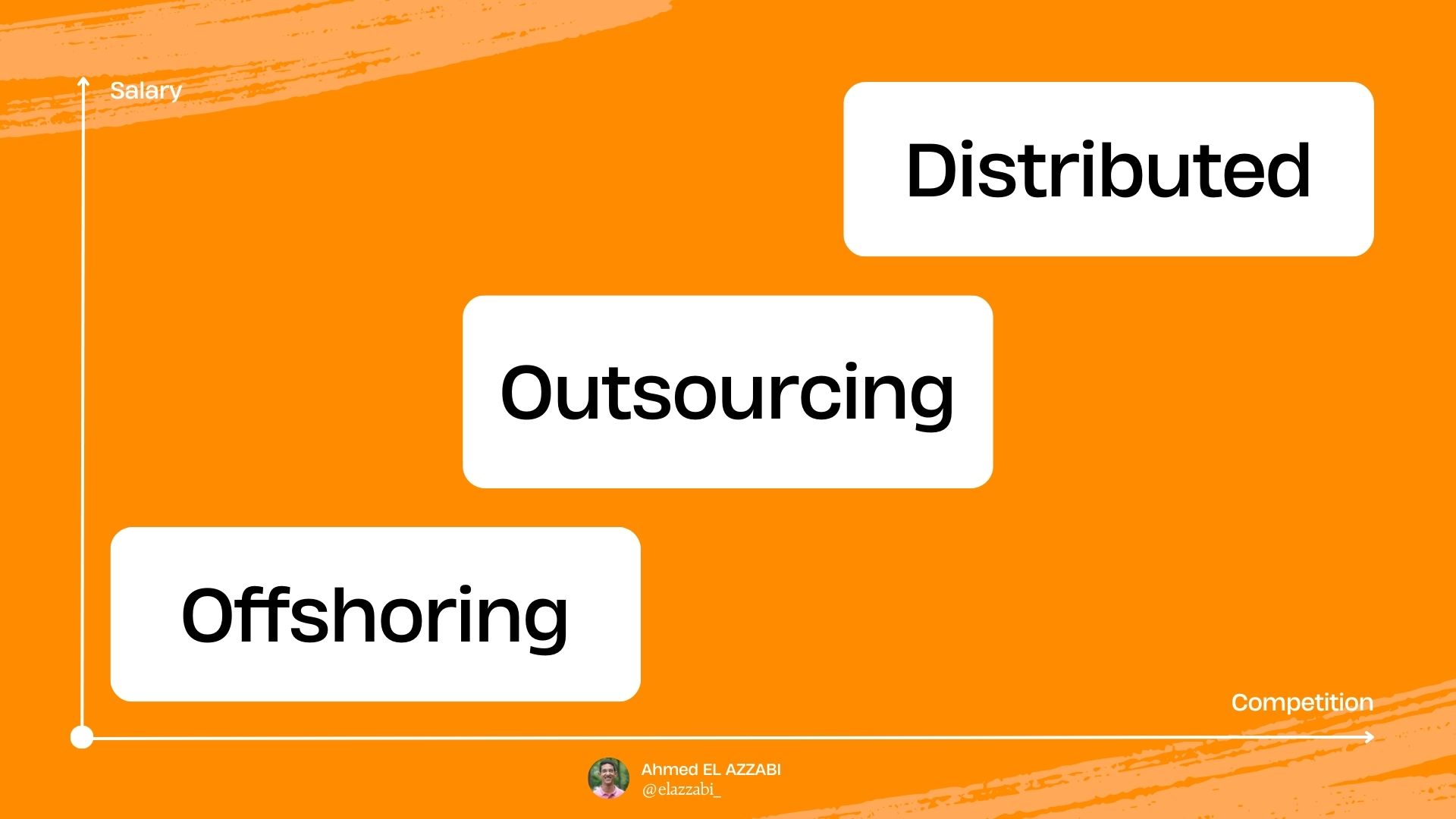
When it comes to salaries, there is no one-size-fits-all. Every company is different, and every salary depends on the position. But, the one thing that can give you a great idea about your salary is knowing the three different company types and how your position fits in:
Offshoring
Offshoring occurs when companies move some of their services or an entire department overseas. For example, a manufacturing company moving customer support to another country is a form of offshoring.
Companies opt for offshoring to reduce their expenses, and when doing so, they choose the most cost-effective options available.
When seeking a remote job with these companies, expect a comparatively lower salary, matching the local ones in your country or slightly above.
Additionally, since these companies offshore entire departments, numerous positions often open simultaneously, offering you more chances to secure a job.
Outsourcing
Outsourcing involves utilizing third-party services, where companies delegate tasks not part of their core business. For example, a manufacturing company decides to outsource its online presence (website or social pages) to a third party.
When companies opt for outsourcing, they usually seek complete delegation. This is why these companies are willing to pay well for that service. However, there is a ceiling to what you should expect.
Because these companies acknowledge that outsourcing is not a full-time commitment, they aren’t providing full-time salaries. Consequently, you may find yourself working with two or three clients concurrently.
If the position evolves into a full-time role, these companies typically prefer internal hiring. And alternatively, for larger projects, they might opt to engage an agency instead.
Given the good pay, expect more competition compared to offshoring.
Distributed
The last category of companies is the distributed type. In these organizations, employees are located globally, collaborating on the same product or service. For instance, consider a software company that operates with a completely distributed model.
When you join these companies, your selection is not contingent on your geographical location or market competitiveness but on your skills. Consequently, these companies typically provide a uniform salary across locations, adjusting for the local purchasing power of each country.
With these companies, the pay is generally excellent, but expect a lot of competition.
In conclusion, understanding the company’s profile (offshoring, outsourcing, or distributed) and where you fit in can provide a good idea about your expected salary. Armed with this knowledge, you can decide which company to apply to based on your salary expectations!
If you need help looking for a remote job, check out our ebook: “Get That Remote Job.”
Get your free copy of Get That Remote Job!
Learn how you can land the remote job of your dreams using my step-by-step process.
- How to develop the required skills for remote work
- How to market yourself online
- How to apply for remote jobs and show your skills
- And more…
